

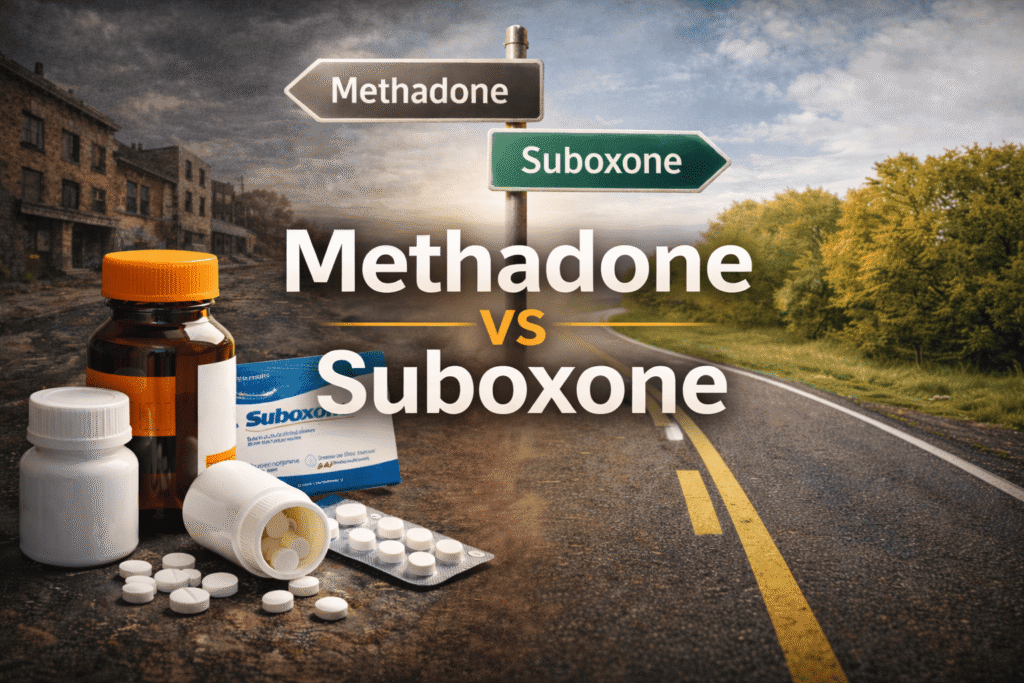
If you’re considering medication-assisted treatment for opioid use disorder, one of the first questions you’ll face is: methadone or Suboxone?
Both are FDA-approved medications that work. Both can help you stop using street opioids, eliminate cravings, and rebuild your life. But they work differently, and the choice between them matters.
As Chief Medical Officer at CORAS Wellness, I’ve spent over 17 years treating patients with opioid use disorder. Since graduating from my family medicine residency in 2009, I’ve practiced nothing but addiction medicine. In this guide, I’ll explain how each medication works, who benefits most from methadone versus Suboxone, and how we help you make the right decision for your individual situation.
How Methadone and Suboxone Work Differently
The key difference between methadone and Suboxone comes down to how they interact with opioid receptors in your brain.
Methadone: Long-Acting Relief
Methadone is what we call a “full opioid agonist.” In plain terms, this means it works on the same parts of your brain as heroin or prescription painkillers do, but in a much safer, controlled way.
The key difference is how long it lasts. When you use heroin or fentanyl, you might feel okay for a few hours, but then withdrawal starts creeping back in. You need to use again just to feel normal.
Methadone sits on the receptor for a long time. When someone uses heroin or fentanyl, after two, three, or four hours they might start experiencing withdrawal symptoms. But with methadone, once we get to the right dose, you won’t experience those symptoms all through the day.
This long-lasting effect is what makes methadone work for people with severe substance use disorder. One dose in the morning keeps you stable all day. No ups and downs. No constant need to find more drugs just to avoid withdrawal.
Methadone is dispensed daily at certified opioid treatment programs like our Delaware clinics, though you can earn take-home privileges as you progress in treatment.
Suboxone: Partial Relief That Blocks Other Opioids
Suboxone contains buprenorphine, which works differently than methadone. It provides enough relief to stop cravings and withdrawal, but it doesn’t activate your brain’s opioid system as strongly as street drugs do.
Think of it this way: if methadone is like filling a gas tank completely, Suboxone fills it about halfway. That’s enough to keep the engine running smoothly, but not enough to create the intense high that leads to substance use disorder.
Suboxone also latches onto your brain’s opioid receptors very tightly. It has a very high affinity for the receptor. So whatever opiate is already there, it knocks it off and it stays there. And because it only partially activates those receptors, it doesn’t give you that high, that euphoria that you get from other drugs.
This tight grip is important. It means Suboxone blocks other opioids from working. If you try to use heroin while on Suboxone, you won’t feel it the same way.
Suboxone contains two medications: buprenorphine (the main ingredient) and naloxone (added as a safety measure). When you take Suboxone correctly by dissolving it under your tongue, only the buprenorphine gets absorbed. The naloxone doesn’t do anything when taken this way. It’s just the buprenorphine that you absorb.
For patients who need to avoid naloxone, like pregnant women, we also offer pure buprenorphine called Subutex.
When You Can Start Each Medication
Here’s something essential to understand about Suboxone: you have to wait until you’re already in withdrawal before you can take your first dose.
Why? Because Suboxone grabs onto your brain’s opioid receptors so tightly. If you still have other opioids in your system and you take Suboxone, it will knock those opioids off and take their place. But since Suboxone doesn’t activate the receptors as strongly, you’ll suddenly feel much worse. This is called “precipitated withdrawal,” and it’s extremely uncomfortable.
Many patients who’ve experienced this say they’re allergic to Suboxone. They’re not allergic. They just took it too early. With proper timing and medical guidance, Suboxone works well.
Both methadone and Suboxone should be started when you’re in withdrawal. This is standard of care because starting medication when you’re not in withdrawal can increase the risk of overdose if the patient is not compliant with proper protocols.
Who Benefits Most from Methadone?
In my experience, methadone is particularly effective for people with:
Long-term, severe opioid dependence
If you’ve been using opioids heavily for years, especially intravenously, methadone provides the level of comfort you need to stabilize.
History of incarceration related to drug use
Many of my methadone patients have spent significant time in jail due to their substance use disorder. Methadone helps break that cycle.
Unstable housing or homelessness
Daily clinic visits provide structure and a safe place to start each day. Our clinics in Dover, Newark, Harrington, Millsboro, and Wilmington open early specifically to accommodate patients who need this consistency.
Need for all-day comfort
If I have somebody who’s been using for a long time, has gone to jail, is shooting drugs, that’s somebody I want to put on methadone because they want to be comfortable all through the day.
Who Benefits Most from Suboxone?
Suboxone tends to work well for people with:
Stable employment
If you have a job and can’t come to a clinic every day, Suboxone works better. Patients can easily get a prescription so they don’t have to come every day, and it won’t obstruct their daily routine.
Shorter duration of opioid use
If I have a patient who has a job, who just started using like a year ago, who has never used intravenously, who has good family support, that’s the kind of patient I might be more interested in starting on Suboxone.
Strong family and social support
When you have a stable support system, the additional structure of daily clinic visits may be less necessary.
Preference for easier tapering
Many patients appreciate that Suboxone’s maximum dose is lower than methadone’s. Some of my more thoughtful patients understand this intuitively: if you’re on 200 milligrams of methadone, it makes sense that it’ll be easier to get off on 24 milligrams of Suboxone.
The Practical Advantages of Suboxone
Suboxone patients can easily get a prescription so they don’t have to come every day, which is one advantage for people with jobs and stable lives. The medication won’t obstruct their daily routine the way daily clinic visits might.
Suboxone Has a Built-In Safety Limit
Suboxone has something called a “ceiling effect.” This means that once you reach a certain dose (usually around 24 milligrams), taking more doesn’t make much difference. Your body can only absorb so much benefit from it.
This ceiling effect is one of Suboxone’s safety advantages. It’s much harder to overdose on Suboxone alone compared to methadone or other full-strength opioids.
Methadone Dosing Process
When you start methadone treatment at CORAS, we increase your dose relatively quickly until you reach a stable, comfortable level. We increase the dose rapidly to get you to a stable dose.
Most patients stabilize somewhere between 60 and 120 milligrams of methadone, though as I mentioned, I have patients who are at 20 and are doing well, and patients at 150 who are not doing well. Everyone is different.
The induction phase for methadone typically takes a few weeks as we gradually find your therapeutic dose.
Safety Considerations: The Real Risks
Yes, it’s possible to overdose on either methadone or Suboxone. But it’s important to understand the actual risk.
It is possible, but most of the time it’s due to another drug that the patient is using. The commonest culprit here is benzodiazepines.
The Real Danger: Mixing Medications
Medications like Xanax, Klonopin, Ativan, and Valium—collectively known as benzodiazepines—are the most common cause of fatal overdoses in patients on methadone or Suboxone. These medications have legitimate uses for short-term treatment of acute anxiety, such as panic attacks. However, they are not the standard of care for long-term anxiety treatment and should only be used for brief periods according to established protocols.
These medications are often legitimately prescribed by other doctors for anxiety or sleep problems. The challenge is that the patient is pushing back on you because their doctor prescribed this and you’re saying that they can’t do it.
When combined with methadone or Suboxone, benzodiazepines become particularly dangerous because they all slow down your breathing. Together, the risk of stopping breathing entirely increases dramatically. In my experience, benzodiazepine use with methadone is the commonest cause of death by overdose that we see in patients on medication-assisted treatment.
Why Methadone and Suboxone Alone Are Safer
Both methadone and Suboxone work slowly in your body. Unlike heroin or fentanyl that hit your brain immediately, these medications are absorbed gradually over time. This slower action makes them much safer when taken as prescribed.
Methadone and Suboxone absorb slowly, so they’re not likely to cause overdose on their own. Patients do overdose, but like I said, it’s due to other drugs that they’re taking, most likely benzodiazepines.
How We Help You Choose at CORAS Wellness
The decision between methadone and Suboxone isn’t made by a formula. It’s made through careful assessment and collaboration between you and our medical team.
Each patient is seen as an individual. That’s where the art of medicine is.
Our Assessment Process
When you come to one of our Delaware locations for MAT outpatient treatment, we consider:
- Duration and severity of opioid use: How long have you been using? What types of opioids?
- Route of administration: Are you using intravenously?
- Employment and daily structure: Do you have a job? Stable housing?
- Family support: Do you have people who can support your recovery?
- History of treatment: Have you tried methadone or Suboxone before? What worked or didn’t work?
- Co-occurring conditions: Do you have mental health issues that need treatment?
- Your preferences: What feels right to you?
Your Voice Matters
Even with medical guidance, your preferences matter. Some patients come in saying they want to do methadone because maybe they have a neighbor or a friend or a relative who has done it and it works for them. I’ll still give them the options, but we have to work with what they want.
This isn’t about doctors dictating treatment. It’s about working together to find what will actually work for you in your real life.
Insurance and Access
The only practical limitations are insurance coverage and availability. We don’t have any limitations on anyone. Actually, the only limitations are if the insurance will cover it or if the patient is willing to try it.
CORAS accepts Medicaid, Medicare, and most commercial insurance plans. We also work with patients who are uninsured through Delaware state-funded programs.
Other Medication Options
While methadone and Suboxone are the most common medications for opioid use disorder, they’re not the only options.
Sublocade (Long-Acting Buprenorphine Injection)
Sublocade is a monthly injection of buprenorphine. Instead of taking medication daily, you receive an injection once a month that provides steady medication levels.
This can be helpful if you struggle with taking daily medication or if there are concerns about diversion (sharing or selling medication).
Vivitrol (Naltrexone)
Vivitrol is a monthly injection that blocks opioid receptors completely. Unlike methadone and Suboxone, it’s not an opioid—it’s an opioid blocker.
The challenge with Vivitrol is that you must be completely off all opioids for at least 7-10 days before starting it. For people with severe opioid dependence, this period of withdrawal can be extremely difficult.
Vivitrol works well for some people, particularly those who’ve already been through detox and want a medication that removes any possibility of getting high from opioids.
The Role of Counseling with Either Medication
Regardless of which medication you choose, counseling is essential.
Medication provides stability—it stops the physical cravings and withdrawal. But it doesn’t address why you started using opioids in the first place.
Our MAT program combines medication with comprehensive counseling and support services. This includes:
- Individual counseling to address trauma, mental health, and personal challenges
- Group therapy to connect with others in recovery
- Case management to help with housing, employment, and legal issues
- Mental health treatment for co-occurring conditions like depression or anxiety
For some patients, we also recommend our PHP/IOP program for more intensive support, especially early in treatment.
If you need more structure than outpatient treatment can provide, our inpatient drug rehab program offers 24/7 support in a residential setting.
Common Questions About Methadone and Suboxone
Can I switch from methadone to Suboxone (or vice versa)?
Yes, but it requires careful medical management. Switching from methadone to Suboxone is particularly tricky because you need to taper down to a low methadone dose first and then wait until you’re in withdrawal before starting Suboxone.
Switching from Suboxone to methadone is easier—you can transition at any time under medical supervision.
How long will I need to be on medication?
There’s no set timeline. Some people are on medication for months; others for years. The decision to taper off should be made when you’re stable and ready, in collaboration with our medical team.
The goal isn’t to rush off medication. The goal is stability, a life where you’re working, maintaining relationships, staying out of legal trouble, and not using street drugs. For many people, medication makes that possible.
Will methadone or Suboxone show up on a drug test?
Standard employment drug tests don’t typically screen for methadone or buprenorphine specifically. However, some specialized tests do.
If you’re required to take drug tests for work or legal reasons, let the testing authority know you’re in prescribed medication-assisted treatment. Being on prescribed methadone or Suboxone is not the same as using illegal drugs.
Can I work while on methadone or Suboxone?
Absolutely. Most of my patients work. Our clinics open at 5:00 a.m. specifically so patients can dose before work.
As you earn take-home privileges in our methadone program, you’ll spend less time at the clinic and more time rebuilding your life.
What if I’m pregnant?
Both methadone and Subutex (buprenorphine without naloxone) are safe and recommended for pregnant women with opioid use disorder. Methadone is considered the standard of care.
We avoid Suboxone during pregnancy because of potential risks from the naloxone component, but Subutex works well.
Treatment during pregnancy is essential—untreated opioid use disorder poses far greater risks to both mother and baby than medication-assisted treatment does.
What Success Looks Like
Success in MAT isn’t just about negative drug screens. It’s about rebuilding a life.
I see patients:
- Getting jobs and keeping them
- Reconnecting with their children
- Repairing family relationships
- Staying out of jail
- Finding stable housing
- Managing mental health conditions
- Regaining their health and dignity
When somebody tells me, “Thank you, doctor. I feel so much better. I have a job now. I’ve gotten my children back,” there’s nothing that feels better than that. At that point I know I’ve made a difference in somebody’s life.
The Bottom Line: There’s No “Best” Medication
Methadone works. Suboxone works. Sublocade works. Vivitrol works.
The question isn’t which medication is best in some absolute sense. The question is which medication is best for you, given your situation, your history, and your goals.
That’s a decision you make with medical guidance—not alone, and not based on what worked for someone else.
If you’re ready to stop using opioids and start rebuilding your life, the first step is getting assessed by medical professionals who specialize in substance use disorder treatment.
Take the Next Step
CORAS Wellness offers comprehensive medication-assisted treatment at our Delaware locations in Dover, Newark, Harrington, Millsboro, and Wilmington.
My medical team will help you determine whether methadone, Suboxone, or another medication is right for your individual situation.
We also provide comprehensive counseling, mental health treatment, case management, and all the support services you need to succeed.
Treatment works. Recovery is possible. And you don’t have to figure it out alone.
📞 Call 833-886-2277 now to speak with our treatment team, or visit any of our Delaware locations to get started.
If you need help with other substance use issues, we also offer specialized programs including our DUI and Alcohol Education Program.
About Dr. Okechukwu Ernest Obua
Dr. Okechukwu Ernest Obua serves as Chief Medical Officer at CORAS Wellness & Behavioral Health, where he oversees medical care for all patients across the organization’s methadone, detox, and rehabilitation programs.
Dr. Obua trained in family medicine at Henry Ford Hospital in Detroit, where he developed a deep interest in addiction medicine after witnessing the confusion and inconsistency in how opioid prescriptions were handled. Since completing his residency in 2009, Dr. Obua has practiced addiction medicine exclusively, specializing in running methadone clinics as a medical director.
Dr. Obua holds the following board certifications and credentials:
- Diplomate, American Board of Family Medicine
- Diplomate, American Board of Substance use disorder Medicine
- Diplomate, American Board of Preventive Medicine (Substance use disorder)
- Fellow, American Society of Substance use disorder Medicine (FASAM)
He attends the annual ASAM conference to stay current on new developments in substance use disorder treatment and evidence-based practices.
His approach to treating opioid use disorder is grounded in compassion and medical science. Opioid use disorder is not different from high blood pressure, not different from diabetes. It is a medical condition that has to be treated. Dr. Obua is known for his individualized approach to patient care, carefully assessing each person’s unique situation to determine the most appropriate treatment plan.
With more than 17 years of experience in addiction medicine and a deep commitment to his patients, Dr. Obua brings both clinical expertise and genuine care to his work at CORAS Wellness.