


If you have ever searched for information about residential treatment for addiction, you have probably found a lot of clinical descriptions that don’t really tell you what it actually feels like to be there. What does a typical day look like? Will you be sitting in a room staring at the walls? Will it feel like a hospital? Will anyone actually care about you as a person?
Those are real questions, and they deserve real answers.
I’m Shelby Stevens, Director of Residential Services at CORAS Wellness & Behavioral Health in Harrington, Delaware. I know what it’s like to walk through those doors not as a staff member but as someone in crisis. My path to working here started there, over ten years ago, when I was homeless, newly postpartum, and fighting to get clean so I could get my son back. What kept me going was not a brochure or a clinical process. It was people who genuinely cared.
That’s what I want to give every person who comes through our residential program now. Below is an honest, inside look at what residential treatment is, what you actually do each day, and why the structure we’ve built here exists to serve you, not just manage you.
What Is Residential Treatment for Addiction, and Who Is It For?
Residential treatment for addiction, sometimes called inpatient rehab, means you live at the treatment facility while you go through recovery. You are not commuting from home to a clinic. You are in a safe, supportive environment around the clock, surrounded by staff and peers who are focused entirely on helping you get better.
At CORAS, our residential program is designed for people who are not safe in their outside environments, who need to step away from the pressures and triggers of daily life, and who need more support than programs like our Intensive Outpatient Program (IOP) alone can provide. As I tell everyone who comes through our doors: the most important thing we offer first is a safe space. Everything else builds from there.
Research from SAMHSA consistently shows that longer, more structured treatment is associated with better long-term recovery outcomes for substance use disorders, including opioid and alcohol use disorder. Residential care allows people to immerse themselves in the recovery process without the distractions and pressures that make sobriety so difficult in early recovery.
What Does a Day in Residential Treatment Actually Look Like?
People have a lot of misconceptions about residential rehab. Some picture it as a sterile hospital setting. Others worry it will feel like jail. Our residential program at CORAS feels like none of that. Here is what a real day looks like.
Morning: Starting With Purpose
The day begins with wake-up, hygiene, and chores. Every resident is responsible for keeping their space clean and their bed made. This is not about control. It’s about building the routines and habits that support a stable life in recovery.
After that, residents come over to the main area for breakfast and a smoke break. I know it might seem like a small thing, but for a lot of people in early recovery, their morning coffee and cigarette are genuinely important to them. We respect that. When someone feels comfortable, they can be present.
The first structured group of the day is what we call Morning Motivation. It begins at 8:15 AM and is designed to set the tone for the entire day. Residents gather in a group room and read from the Just for Today from the NA workbooks is one example of the kind of short motivational readings used to open the group. Everyone shares what their goal is for that day and an affirmation they want to hold onto. Staff share any announcements for the day. It is not a long group, but it matters. It shifts the energy in the room. It makes the day feel intentional.
At the bottom of the Morning Motivation form, residents answer a set of private questions, not to be shared openly, that ask if they had any drug dreams the night before, and how they are feeling on a scale of one to ten. If anyone scores below a five, a staff member checks in with them one on one. If something more serious is reported, they meet with their counselor directly. Nothing gets overlooked.
Daytime: Treatment, Groups, and Real Work
The first clinical group starts at 9 AM. Clinical groups are led by our counselors and are focused on education and processing. One of our counselors structures his groups so that the first half is educational content and the second half is processing time, where residents can talk about what came up for them. When a topic is particularly heavy, he splits the processing into a smaller group setting so people feel safe enough to share.
Throughout the day, residents also participate in peer-led groups run by people who are themselves in recovery. These groups tend to be more conversational and motivational. Residents share their stories, talk through what’s working and what isn’t, and celebrate milestones like clean time anniversaries. These groups feel different from clinical ones, and they matter in a different way. Hearing from someone who has been exactly where you are is powerful in a way that nothing else quite matches. Our staff, including me, are largely in recovery ourselves. We are not standing at a distance. We are in it with you.
Built into the schedule is also dedicated time for residents to work on homework assigned by their counselor, specific exercises tied to their individual recovery plan that they work through and then review together during their one-on-one sessions. Individual therapy happens throughout the day as well.
The afternoon includes another clinical group at 1 PM, individual therapy, caseload groups, and a peer group at 4 PM. Meals and medication times are woven throughout, along with smoke breaks between sessions.
Outside Resources: Bringing the Community In
One of the things I’m most proud of is that our residential program reaches outside its own walls to bring real-world resources to our residents.
A representative from Stand by Me, a financial literacy and budgeting program, comes in to work with residents on money management, saving, and even setting up savings accounts. For a lot of people in recovery, money has been a source of chaos and shame. Learning how to manage it in a safe environment is genuinely transformative. She always ends up staying way past her scheduled time because residents have so many questions, and she answers every single one.
The food bank comes in to give presentations on healthy eating and programs like WIC, and actually brings food so residents can see what they can prepare without a full kitchen. We have also had outside speakers do yoga and mindfulness sessions, sound baths, and other wellness activities. Not every person connects with every activity. But we want residents to experience a wide range of what a life in recovery can look and feel like.
We also take residents off-site to community groups through Impact Life, which operates a resource and community hub, and to bowling, movies, and other outings. We are going to be adding a karaoke machine soon because I genuinely believe that laughter and joy and goofiness with your peers is part of healing. Our staff will be up there singing too. Most of us are in recovery. We do not stand apart from our residents. We live this with them.
Evening: Reflecting and Winding Down
The day closes with dinner, a smoke break, and what we call Evening Reflection or Wrap-Up. This mirrors the Morning Motivation in structure. Residents revisit the goal they set in the morning: did they complete it? Why or why not? How are they feeling now? They again answer private questions, this time about any cravings they experienced during the day.
After that, every night includes an NA group. Sometimes residents go off-site for an NA or AA meeting. We have an in-house meeting on Friday nights where outside members of the recovery community come to our facility. And sometimes the group just runs it themselves internally. After the NA meeting, residents have free time. There are TVs, a ping pong table, a basketball hoop, workout equipment, and cornhole. The evenings are calmer, but they are still structured and intentional.
What Does the Living Space Look Like?
The residential living area, where residents sleep and spend their free evenings, is separate from the main clinical area. The two sections connect through a badge-accessed hallway. On the clinical side are offices, group rooms, a peer lounge, a meditation room, a phone for residents to use, the dining room, and the kitchen.
A significant construction renovation is currently planned, including a courtyard in the back of the building. The facility is going to be beautiful. But I want to say something honestly: the physical building has never been what keeps people coming back. I have had residents return to our program again and again over the years, and when I ask them what brought them back, they always say the same thing. It is the staff. It is how they feel here. It is knowing that when they walk through the door, someone is genuinely going to be glad they made it.
What Are the Different Levels of Residential Care?
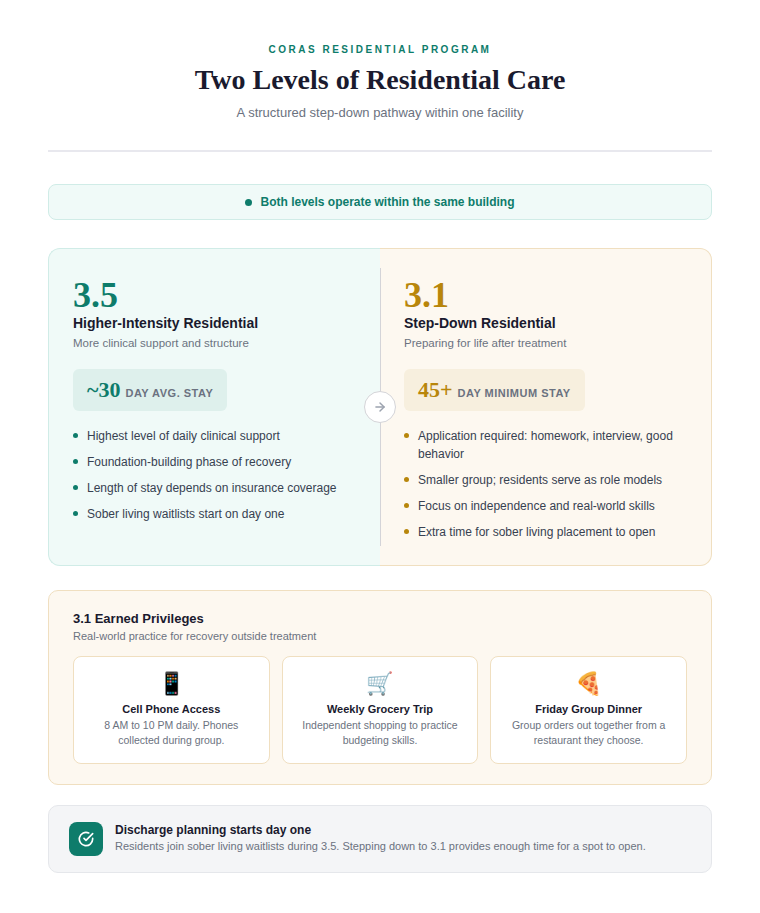
Our residential program has two levels of care, both located within the same building.
Level 3.5: Higher Level of Residential Care
The 3.5 level is a higher intensity of care, appropriate for people who need more clinical support and structure. The average length of stay at 3.5 is approximately 30 days, though this depends largely on insurance coverage. Thirty days feels short, and it is. But it is where the foundation gets built.
If you want to understand how long treatment for opioid or alcohol use disorder typically takes and why, our article on how long opioid use disorder treatment takes goes into more depth on that question.
Level 3.1: Step-Down Residential Care
After completing the 3.5 level, many residents step down to 3.1, a lower level of care within the same building. The 3.1 program is designed to extend a resident’s stay and focus on preparing them for life after residential treatment. The average stay at 3.1 is 45 days at minimum.
To be accepted into the 3.1 program, residents go through an actual application process, which includes submitting their homework, having an interview with the clinical team, and demonstrating that they have been maintaining good behavior. The 3.1 program has fewer residents, and we expect them to serve as role models.
3.1 residents earn meaningful privileges. They can have their cell phones from 8:00 AM to 10:00 PM, though phones go into a basket during group time. They are allowed to go to the grocery store once a week to practice the budgeting skills they have been learning. And every Friday, the 3.1 group gets to order out together as a group from wherever they collectively decide. These privileges are not gimmicks. They are real-world practice for the independence and responsibility that recovery in the outside world requires.
Discharge planning begins from day one, including getting residents on waiting lists for sober living environments while they are still in the 3.5 program. Stepping down to 3.1 often gives them enough additional time for their spot at a sober living to open up.
Is Medication-Assisted Treatment Available in Residential Care?
Yes. Medication-assisted treatment (MAT) is available right on-site at our residential program, which is a significant advantage for many residents. If you are already on a maintenance medication and are using on top of it, our provider can work with you to adjust your dose so that you are comfortable and stable. Our guide to methadone treatment explains how MAT works in more detail. If you are using stimulants like cocaine, which do not have a formal detox protocol, our providers can still see you and treat symptoms like depression to help you get comfortable as quickly as possible.
For people who are not yet on MAT and who are experiencing significant active withdrawal, particularly from alcohol, we typically recommend going to a detox program first for medical stabilization before coming to us. Detox is a short process, usually around five days, and its only purpose is to get you physically stable. The actual treatment happens here. If you want to understand the difference between these two options in more depth, read our article on detox vs. residential treatment.
We also have detailed guides on methadone treatment, what to expect at a methadone clinic, and methadone vs. Suboxone if you want to learn more about your medication options.
What Is an Individualized Recovery Plan, and How Does It Work?
When you arrive at our residential program, you go through a comprehensive intake process. You meet with a nurse for a nursing assessment, with our mental health provider for a psychiatric assessment, and with our medical provider for a full physical examination. Your counselor also completes a biopsychosocial assessment with you, which is really just a thorough conversation about your history, your needs, and your situation.
All of that information comes together to build your individualized recovery plan. This plan covers six dimensions of your life and recovery:
- Your withdrawal management and MAT needs
- Your medical needs
- Your emotional and behavioral health, including any mental health conditions
- Your legal or family services involvement, such as probation or DFS
- Your risk factors for relapse and what we can do to address them
- Your motivation and what you want your life to look like
A lot of people arrive at our program having struggled with more than just substance use. Many come in without housing. Some have developed survival behaviors like stealing that they picked up during periods of homelessness. We do not judge any of it. We address it. Because if your needs are not being met, you cannot even begin to focus on recovery. Our job is to make sure that while you are with us, everything you need is taken care of, and that when you leave, you have a plan that sets you up for real success.
Counseling is a central part of how we work through all of this. If you want to understand why that matters, our article on why counseling matters in opioid addiction treatment explains it well.
What Happens After Residential Treatment?
The goal of our 3.1 program is to prepare you for what comes next. We strongly encourage residents to transition to a sober living environment after leaving our program. Sober living gives you a structured, supportive environment as you reintegrate into daily life, and it significantly improves long-term outcomes. We have relationships with sober living options throughout Delaware, and we work to get you on a waiting list early so there is no gap between leaving us and landing somewhere safe.
Many residents also transition into our Intensive Outpatient Program (IOP) after leaving residential care. IOP provides continued clinical support while you begin to live more independently. Some sober living environments require IOP participation as a condition of residency. Our article comparing IOP and PHP in Delaware can help you understand the difference between those two levels of outpatient care.
If cost or insurance coverage is a concern, we also have information available about IOP programs in Delaware and IOP options for those without insurance.
What If Treatment Doesn’t Work the First Time?
I want to be honest with you about this, because I think it matters more than anything else I could say.
Recovery is not always linear. Some people leave our program and do incredibly well. Some struggle and end up using again. If that happens to you, I want you to know something: there is no shame in coming back. None.
I have had people come through our doors three, four, five times before something finally clicked. I have also had people I loved never make it back. I have gone to funerals and held their mothers. So when someone does come back, I am not going to ask them what went wrong or why they didn’t call. I am going to give them a hug and tell them I am so glad they are alive.
Every time you come back, you learn something new. Every attempt is not a failure. It is part of a process. And I believe that for the people who keep trying, there is a point where it sticks.
The residents I have seen do best long-term are the ones who found something to live for, something that genuinely motivated them. Getting your children back. Rebuilding a relationship. Getting clean enough to hold a job you actually care about. We work with each person to find that thing, because information and groups alone are not always enough. You have to want a life in recovery. And our job is to help you see that such a life is possible and worth having.
The People Who Make This Program Work
I want to say something about our staff, because I think it is genuinely part of why CORAS is different.
Most of our staff are in recovery themselves. Our counselors, our peers, our director. We are not observing our residents from a clinical distance. We know what it is like to sit in that chair. We know what it is like to not know if you are going to make it. And that changes everything about how we show up.
We have even hired alumni of our own program. One person completed the 3.5 and 3.1 programs, went into sober living, attended IOP, maintained sobriety for two years, and kept coming back to lead groups and share his story with current residents. I eventually hired him, and he now works on our staff. That is not an anomaly. That is our vision for what recovery can look like.
I always tell residents: stay clean, show up, give back, and come back to see me in two years. That door is open. And it means something to the people still in the program when they can see someone who was exactly where they are, sitting across from them, telling them it is possible.
Where Is CORAS Wellness Located?
Our residential program is based out of our Harrington location. CORAS Wellness also operates outpatient and MAT services at locations across Delaware, including Dover, Newark, Millsboro, and Wilmington. Wherever you are in Delaware, there is a CORAS location near you.
Frequently Asked Questions About Residential Rehab
How long is residential treatment at CORAS Wellness?
The average stay at our 3.5 level of care is approximately 30 days, depending on insurance coverage. Residents who step down to our 3.1 program typically stay an additional 45 days or more. Discharge planning begins from day one, so your aftercare plan is being built throughout your entire stay.
Is residential treatment locked down? Can I leave if I need to?
Our residential program is structured and supervised, but the doors are not physically locked. You are free to leave at any time, though our staff will always encourage you to stay and work through whatever you are feeling. One reason we often recommend going to detox before residential care is that detox facilities typically have locked doors, which gives you a period of enforced stability during the hardest physical days of withdrawal before you transition to us.
Can I be on medication-assisted treatment during residential rehab?
Yes. MAT is available on-site throughout your residential stay. If you are already on a maintenance medication, our provider can adjust your dose to keep you comfortable. If you are not yet on MAT, our medical team will evaluate what is appropriate for your situation.
What is the difference between detox and residential treatment?
Detox is a short-term, medically focused process, typically around five days, designed solely to stabilize you physically through withdrawal. It is not treatment. Residential treatment is where actual recovery work happens: counseling, group therapy, life skills, relapse prevention, and building an aftercare plan. Most people benefit from completing detox before coming to residential care, though there are exceptions depending on your situation.
Do I have to go to detox before residential treatment?
Not always, but usually it is safer. If you are experiencing significant active withdrawal, especially from alcohol or opioids, going to detox first is strongly recommended because we do not have 24/7 medical care on-site. However, if you are already on a maintenance medication or if your primary substance is a stimulant, we may be able to work with you directly. Every situation is evaluated individually.
What happens after I leave the residential program?
Most residents transition to a sober living environment, which we believe provides the best foundation for long-term success. Many also continue care through our Intensive Outpatient Program (IOP). Aftercare planning is a core focus of the 3.1 level of care, and we begin building your plan from day one of your residential stay.
What if I relapse after leaving residential treatment?
Come back. Seriously. There is no shame in returning. Recovery often takes more than one attempt, and every time a person returns, they bring new insight and a deeper understanding of what they need. Our staff will welcome you back with open arms. What matters is that you make it back alive.
Is CORAS Wellness co-ed?
Yes. Our residential program is co-ed and serves adults of all genders at both the 3.5 and 3.1 levels of care.
Does CORAS accept Medicaid for residential treatment?
Yes. CORAS Wellness accepts Medicaid and works with a variety of insurance plans. Contact us directly and we will help you understand your coverage options and what to expect financially. Cost should never be the reason someone does not get help.
Ready to Take the Next Step?
If you or someone you love is struggling with opioid or alcohol use disorder, our team at CORAS Wellness is here to help. Our residential program provides the safe, structured, compassionate environment that makes real recovery possible. We also offer medication-assisted treatment, IOP and PHP programs, and a full continuum of care across Delaware.
Call us today at 833-886-2277 for a confidential conversation. There is no obligation, and no judgment. Just people who understand what you are going through and know how to help.
We serve communities across Delaware from our locations in Harrington, Dover, Newark, Millsboro, and Wilmington.
———
About the Author
Shelby Stevens | Director of Residential Services, CORAS Wellness & Behavioral Health
Shelby Stevens has spent over a decade working in addiction treatment at CORAS Wellness, holding nearly every role in the organization before being appointed Director of Residential Services by the current ownership team, who recognized in Shelby what clients have always known: a genuine, non-judgmental commitment to the people in their care.
Shelby’s path into this work began as a client. After becoming homeless following the birth of her son in October 2016 and losing temporary custody, Shelby entered a residential program at what is now the CORAS Harrington facility, where she got clean, regained custody of her son, and built a career from the ground up. She has served as a live-in peer, peer supervisor, and now director, and has personally hired alumni of the program to join the CORAS staff.
Shelby brings both lived experience and professional leadership to her role, and her philosophy of recovery is simple: every person who walks through that door deserves to feel safe, cared for, and never ashamed. Recovery is possible. She is proof of it.
CORAS Wellness & Behavioral Health | Residential Program: Harrington, DE | 833-886-2277
